CDA Technical Institute of the West Indies, Inc. offers the most comprehensive and rigorous commercial diving program, covering all the skills needed to succeed as a commercial diver.
CDAWI trains new divers in a shallow lagoon, letting them get comfortable with the equipment before moving into open water. The training is progressive, starting out shallow (5 meters) and ending with deep dives (30 meters). This type of training not only builds confidence, but it also builds competency.
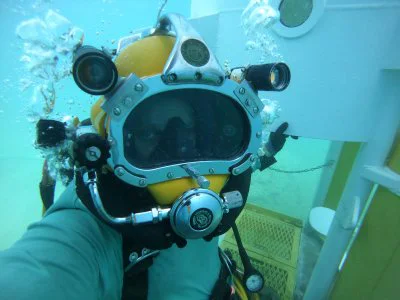
The deep diving portion of the training is done from the ship DSV Pipeline Surveyor. The ship is outfitted with multiple dive stations and a wet bell with a L.A.R.S. system and hyperbaric chamber (DDC 54"). Students train on the DSV Pipeline Surveyor, where they dive to depths of up to 30m (99/ft). Surface-supplied diving on the DSV Pipeline Surveyor uses advanced equipment, including a Type II Dive Bell, Hot Water Machine, and Advanced Video Displays, to meet the training requirements of the NASE WORLDWIDE Divers Certification Board (NASE). Upon successful completion, divers will earn the NASE Surface-Supplied 30m Air Diver certification.
This is the only commercial diving program in the Caribbean to qualify students to receive certifications from ALL of the following:
Surface-Supplied 30m Air Diver Certification from the Divers Certification Board of NASE WORLDWIDE (DCBNASE), allowing our graduates to work worldwide
Certificate of successful completion of Topside Welding for Commercial Divers from CDAWI, in accordance with American Welding Society (AWS) standards -- This training provides the foundation necessary to seek a career as a commercial diver
Certificate of successful completion of Underwater Welding from CDAWI -- An additional qualification provides the skills necessary to weld underwater*
NASE First Aid, CPR, AED & O2 Provider Training (includes Oxygen First Aid, AED use, First Aid for Hazardous Marine Life, CPR First Aid and Bloodborne Pathogens) -- Required for all employees in the industry
Certificate of successful completion of Offshore Survival from CDAWI
Certificate of successful completion of CDAWI UWNDT from NASE, meeting the standards set forth by API & American Society for Nondestructive Testing (ASNT) for Levels I & II Visual Inspection, Magnetic Particle and Ultrasonic Thickness for underwater use**
Certification from (NASE) for Basic Rigging and certification for Basic Mechanical Aptitude, including Hand and Power Tools, Safety, Blueprint reading -- These skills are a part of the CDAWI Advantage and go beyond the standard diver training
*The following certification requires successful completion of the practical portion of the Underwater Welding course to receive the Underwater Welding Qualification Specialist for Class C fillet weld to AWS D3.6M 2010. For more information on underwater welding, please see Page 21 of AWS D3.6M 2010 or feel free to call Admissions for details.
** These skills are a part of the CDAWI Advantage and go beyond the standard diver training.
To enroll, click here.
Outline:
Diving Physics
Diving Physiology, Decompression, & Emergency Management Procedures
Diving Equipment, Systems, & Procedures
Practical Use of Diving Equipment
Diving Hazards & Legislation
Diver Communication Systems
Rigging
Underwater Inspections & Searches
Hand & Power Tools
Water Jetting, Airlifts, Venturi Dredges, & Lift Bags**
Cutting & Welding Equipment**
Underwater Construction Techniques**
Hyperbaric Chamber Operations**
** These are topics that are not required for certification but are included as part of the "CDA Advantage."
Program Costs
Tuition - $24,800.00
Registration Fee - $100.00
Equipment - $3,000.00 (estimated)
Open Water Certification - $750.00 (if not already certified)
Diver Physical - $699.00 - NASE Approved
Additional Costs
Housing - $1,500.00USD - 2,500.00USD per month (estimated)
Food - $1,500.00USD - 2,500.00USD per month (estimated)
Car Rentals - $70.00USD - 120.00USD per day
Length of Course
The CDA Technical Institute of the West Indies program of study requires a minimum of 8 weeks. The maximum number of weeks a student may participate in training is 14 weeks.
Practical Experience Hours - 260
Classroom Hours - 220
Total Hours - 480
Number of Weeks - 8
5 Days per week / 12 Hours per day